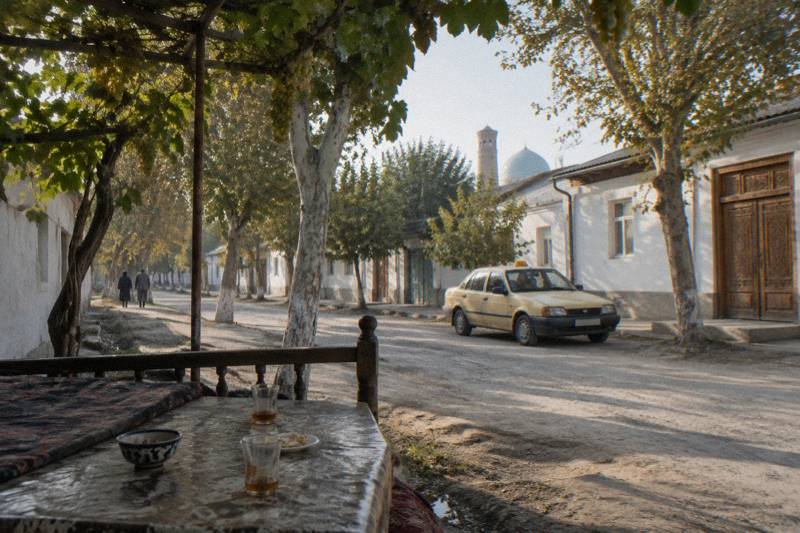
Can You Still Travel The Silk Road?
The overland Silk Road caravans are gone, but the Uzbek section is one of the most bookable routes in Asia. Here is what Silk Road travel looks like today, city by city, train by train.
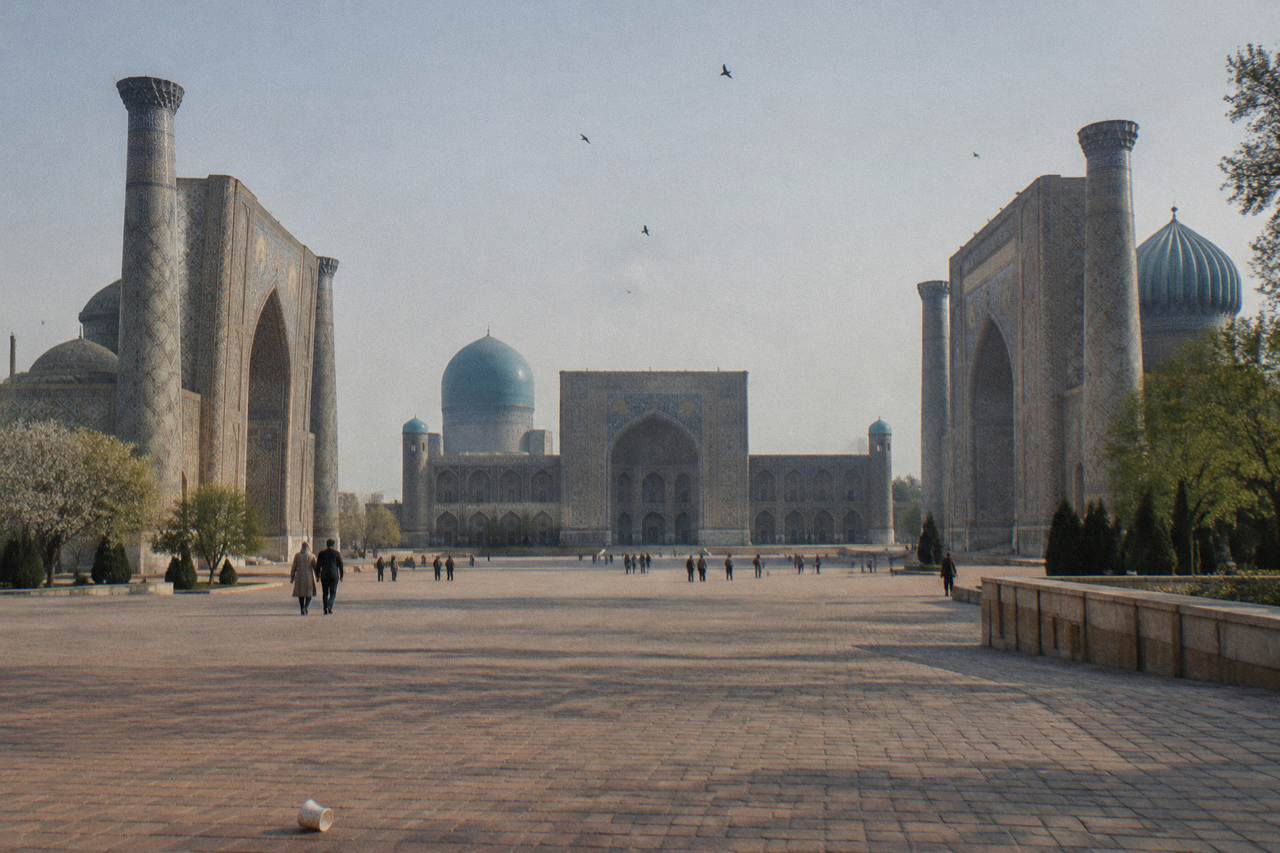
Can You Still Travel The Silk Road?
Yes, you can, and the Uzbek section is the part that works best. The caravan routes faded centuries ago, but the cities they created, Tashkent, Samarkand, Bukhara and Khiva, are open, connected by high-speed rail and served by bookable guided tours from $15 to $1,600 per person. What you travel today is a route of monuments and trains, not camels.
That answer surprises people who picture the Silk Road as a single road at all. It never was one. The name covers a shifting web of caravan paths that crossed Central Asia for centuries, and the stretch through what is now Uzbekistan held the densest cluster of trading cities on the whole network. Those cities are the reason the route survives in a travelable form: the trade built the architecture, the architecture survived, and the architecture is now what you go to see. For a closer look at what survives beyond the famous facades, read what still exists of the Silk Road today.
A few things make the modern version genuinely easy in a way it was not a decade ago. US citizens can enter visa free for up to 30 days from 1 January 2026 under a presidential decree published on the government portal, so the paperwork barrier that used to define Central Asia travel is gone for American passports. A new high-speed train to Khiva is reported to have launched in May 2026, closing the last awkward gap on the classic circuit. And the tour market has matured: this site compares 35 bookable tours across the four cities, from a $15 walking tour to an 11-day private package from $1,600 per person.
The honest answer to the question is a guided Uzbekistan circuit, which is the product most travelers end up buying. Doing it independently is possible and rewarding, but the guided version is what turns four cities, two trains and a fistful of monument tickets into one booking.
Three tours frame the choice. The 5-day Silk Road Secrets Tour in Uzbekistan runs from $856 per person and compresses the route into the shortest guided circuit on the roster. The 8-day private train tour from $1,035 per person, rated 4.7 from 40 reviews, covers Tashkent, Urgench, Bukhara and Samarkand with meals listed. And the Samarkand historical monuments walking tour, rated 4.9 from 1,104 reviews and from $15 per person, shows what the city-level end of the market looks like: cheap, frequent and genuinely good.
Did The Silk Road Go Through Uzbekistan?
It did, and not marginally. Samarkand, Bukhara and Khiva were among the richest trading cities on the entire network, and the caravan routes that crossed what is now Uzbekistan connected China and Persia for centuries. Modern Uzbekistan holds three of the most celebrated Silk Road city centers anywhere, which is why nearly every guided route concentrates there.
The geography explains the cities. Caravans crossing between the great empires to the east and west needed staging posts with water, walls and markets, and the oasis belt through this region supplied them. Samarkand grew rich as a junction where goods changed hands. Bukhara became a center of trade and learning so significant that its name traveled far beyond the region. Khiva, closer to the western desert edge, worked as a waypoint on the northern branch of the route.
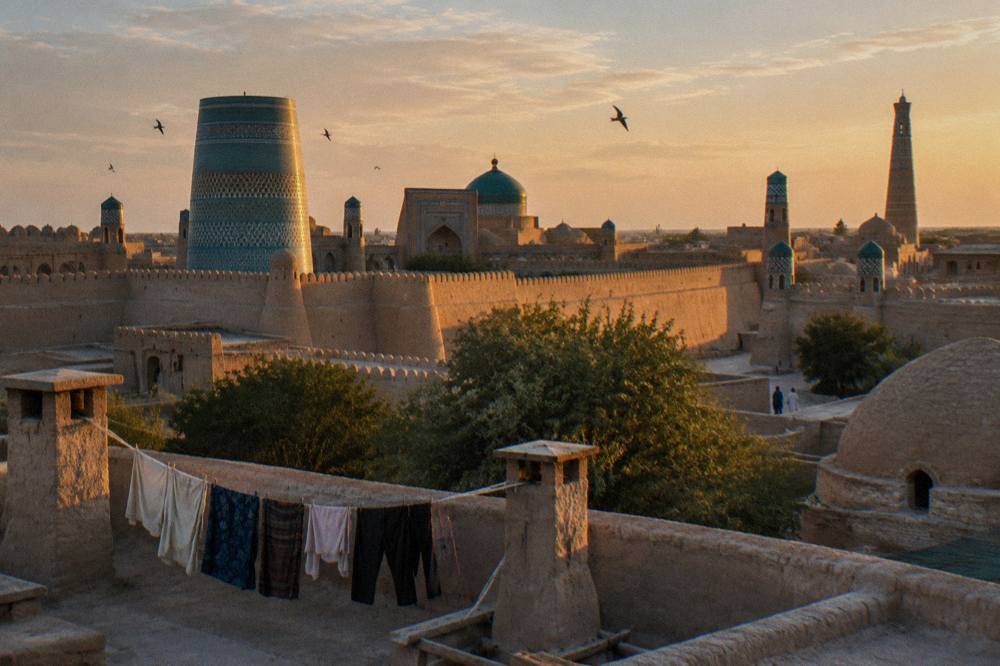
You can still read that logic in the street plans. The old towns are compact, walled and organized around covered markets, caravanserais and mosque complexes, exactly the infrastructure a caravan economy required. Khiva's Itchan Kala is the starkest case: an intact walled inner city where the defensive and commercial logic of the caravan era is legible in a single walk. Bukhara's old town clusters around pools and domed market halls. Samarkand's great square gathers the monumental architecture that a trading empire at its peak could fund.
What that means practically is that "traveling the Silk Road" in Uzbekistan is not a symbolic gesture. The route's core urban heritage is the country's main product, protected, ticketed and guided. For a first visit, the standard question is how many of the four cities to include, which is covered in depth in our guide to how many days and which route.
The guided option is worth a hard look at this decision point. The Silk Road Secrets Tour is the roster listing built most explicitly around the route itself: five days from Tashkent, from $856 per person, with pickup, meals and free cancellation listed on the operator's page. It has only 8 reviews so far to mean much, but the shape of the itinerary is the classic four-city compression. The listing is the place to confirm dates and current pricing.
What Does Silk Road Travel Look Like Today?
In practice it is a city-hopping circuit: fly into Tashkent, ride high-speed trains to Samarkand and Bukhara, reach Khiva by train or air via Urgench, and tour each old town on foot with a local guide. Everything is bookable online, sites are open with no widespread closures reported, and the whole loop fits in five to eight days.
The mission core of the route has not changed even as the transport has. A traveler in the medieval era moved between the same four urban anchors, resting, trading and paying for protection at each one. You will do the same, minus the protection fee, plus a seat reservation. Here is how each stop works now.
| Stop | What You See Today | How To Reach It |
|---|---|---|
| Tashkent | Capital city, metro stations, bazaars, new Islamic Civilisation Centre reported open from about March 2026 | International flights including a nonstop from New York JFK of about 12 to 12.5 hours |
| Samarkand | Registan square, shrine-lined avenues, covered bazaars, craft workshops | High-speed train from Tashkent, about 2 hours to 2 hours 30 minutes |
| Bukhara | Walled old town, citadel, domed market halls, poolside squares | High-speed train from Samarkand, about 1 hour 12 minutes to 1 hour 50 minutes |
| Khiva | Itchan Kala walled inner city, minarets, caravanserai courtyards | New high-speed train reported from May 2026, about 7.5 hours from Tashkent, or a domestic flight to Urgench of about 1 hour 30 minutes |
Two things in that table deserve emphasis. First, the distances that defined the caravan era are now train rides measured in a couple of hours on the main corridor. The Tashkent to Samarkand to Bukhara spine is one of the better-served rail corridors in the region, with several departures a day. Second, Khiva remains the one stop that costs you half a day of travel, which is why shorter itineraries sometimes cut it and why the 8-day tours that include it feel noticeably more complete.
For planning depth on the pacing question, the piece on choosing a Silk Road route that fits breaks down the trade-offs by trip length. The short version: five days works if you accept a compressed Khiva stop, seven to eight days is the sweet spot, and anything longer opens side trips like the Aral Sea or the mountain towns.
Getting Between The Cities: Trains, Flights And Roads
The Tashkent to Samarkand to Bukhara corridor runs on Afrosiyob high-speed trains, about 2 to 2.5 hours and about 1 hour 12 to 1 hour 50 minutes per leg, with several departures daily and economy fares from about $25 to $40 on the first leg. Khiva is reached by a reported new train of about 7.5 hours or a short flight to Urgench.
Rail is the defining comfort of modern Silk Road travel. The Afrosiyob service covers the main corridor fast enough that a two-city day trip is realistic, and the slower Sharq trains undercut it on price if your schedule is loose. Fares are best quoted as ranges: the verified research holds agency-quoted prices of about EUR 40 economy on Tashkent to Samarkand, about EUR 60 on Tashkent to Bukhara, and those move with dates and demand. Tickets open on the official railway booking site roughly 30 to 45 days ahead, and foreigners can buy online with passport details, though international card acceptance is reported to vary. More of these guides are collected on Uzbekistan Tour Packages.
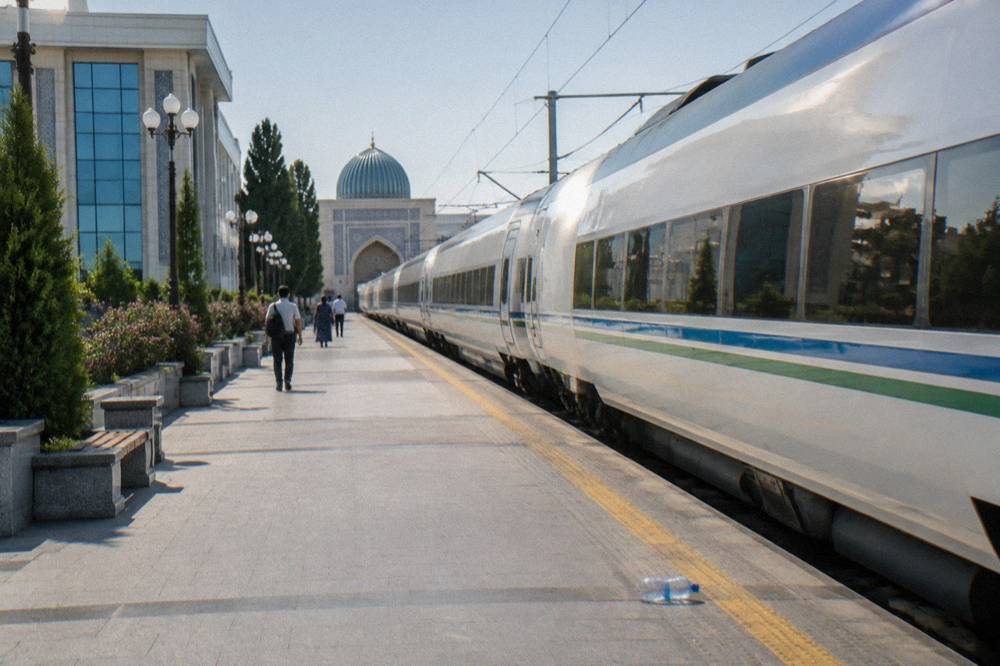
The Khiva line is the big recent change. The Jaloliddin Manguberdi service is reported by tourism press to have launched in early May 2026, running about 7.5 hours from Tashkent around three times a week, with a fare of about 780,000 som, roughly $65. Reports are the operative word: days and times should be confirmed on the official railway ticketing site before you build an itinerary around it, because new services get adjusted in their first year. The alternative is a domestic flight to Urgench of about 1 hour 30 minutes, from about 442,000 to 484,000 som one way, followed by a short road hop into Khiva.
Road remains the fallback and, in one place, the better choice. The Khiva to Bukhara drive crosses desert and passes a chain of ancient fortress ruins, which is why some of the most interesting roster listings turn that transfer into a sightseeing day. The transfer with five fortress stops runs 10 to 12 hours, is rated 5.0 from 111 reviews and costs from $220 per person, price varying by group size. It is the closest thing on the market to traveling the way the caravans did, overland between the oasis cities, with the ruins to prove it.
If you would rather hand the rail logistics to someone else, the roster has a listing built exactly for that. The 2-day tour to Bukhara and Samarkand from Tashkent by train costs from $499 per person, is rated 4.9 from 57 reviews, and includes pickup, meals and free cancellation on the operator's page.
That listing suits travelers with a weekend and a train fixation. For everyone else, most multi-day packages fold the train tickets, transfers and hotels into one price, which is the quieter argument for the guided circuit: the rail system is easy but not frictionless, and a package removes the booking-window arithmetic entirely.
What Is The Best Silk Road Tour?
For most travelers the best fit is the 8-day private train tour from $1,035 per person, rated 4.7 from 40 reviews, which covers all four cities with meals listed. Shorter trips are well served by the 5-day Silk Road Secrets tour from $856, and budget travelers can assemble a strong route from city walking tours starting at $15 to $23 per person.
"Best" depends on days and dollars, so here is the honest comparison across the roster's Silk Road listings. Each tour below shows its from-price, rating and review count; where reviews are few, treat the score as a rough guide.
| Tour | Days | Price | Rating | What Stands Out |
|---|---|---|---|---|
| 8-Day Private Train Tour, Meals | 8 | from $1,035 pp | 4.7 from 40 reviews | Full four-city circuit, meals and pickup listed |
| 6-Day Private, Meals Included | 6 | from $800 pp | 4.9 from 48 reviews | Same cities, tighter pace, strong rating |
| 5-Day Silk Road Secrets | 5 | from $856 pp | 8 reviews | Shortest route-branded circuit |
| 7-Day Local Guide, Mountains | 7 | from $1,075 pp | 5.0 from 21 reviews | Adds mountain scenery to the circuit |
| 11-Day Magical Cities, Meals | 11 | from $1,600 pp | 10 reviews | Longest, most relaxed pacing |
| Budget 6-Day Private From Tashkent | 6 | from $632 pp | 10 reviews | Cheapest multi-day option on the roster |
A pattern worth noticing: the reviews cluster on the mid-length tours. The 6-day and 8-day listings carry the deepest review pools and the strongest ratings, which is what you would expect from the products most travelers actually choose. The longer and shorter options are real and bookable but have thinner feedback, so read their itineraries carefully rather than leaning on ratings.
City-level tours are the budget alternative and they are genuinely excellent. The Samarkand historical monuments walking tour is rated 4.9 from 1,104 reviews, from $15 per person, and is the most reviewed listing in the entire Samarkand set.
Assembled on your own, a week of walking tours, trains and guesthouses lands somewhere in the mid-range daily budget of $60 to $120 per person excluding flights, against the package prices above. The trade is time and coordination for money. If you want the full breakdown, our cost piece on what a trip across Uzbekistan actually costs runs the numbers by trip length.
Can You Do The Silk Road Independently?
Yes, and thousands do. A solo circuit works best if you book trains as soon as the window opens, carry cash for guesthouses and monument tickets since cards are unreliable outside big hotels, and budget $25 to $50 per day on a backpacker plan or $60 to $120 mid-range, excluding flights. The hard parts are rail timing and Khiva logistics.
Independent travel here is far from wilderness trekking. The cities are tourist-ready, the trains have an official booking site with English support, and the old towns are compact enough that a printed map covers them. What catches people is the plumbing. Guesthouses, bazaars, small eateries, taxis and monument ticket windows run on cash, in som, and the exchange rate sits at about 11,900 som per US dollar. Cards work at mid and upper hotels, malls and many tourist restaurants in the four big cities, but the further you get from those, the more cash matters. ATMs exist in the main cities and airports, dispense som, and commonly carry fees plus withdrawal limits, so most independent travelers exchange clean US bills in town.
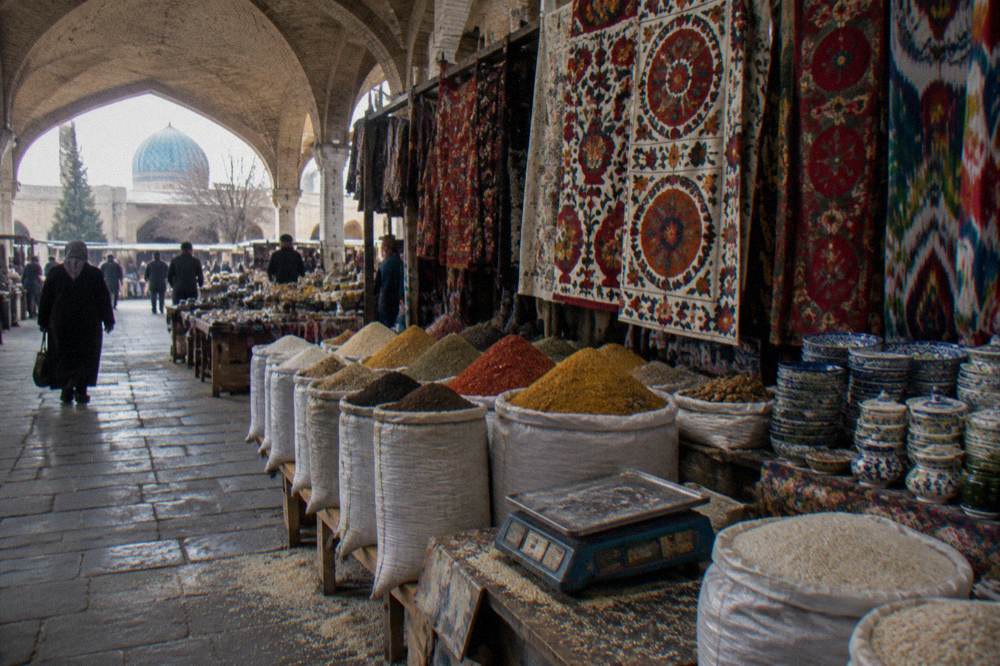
Monument fees are the other budget line people underestimate. The verified research holds approximate figures: the Registan ensemble at about 70,000 to 100,000 som, Bukhara's Ark at about 60,000 som, and Khiva's Itchan Kala combined ticket at about 150,000 som standard, with a fuller version at about 240,000 to 250,000 som valid for two days. Those are "about" numbers and they trend upward, so treat them as planning ranges and check at the gate. There is no single pass covering sites across cities; each museum-reserve sells its own.
Safety rarely turns out to be the blocker people expect. The US State Department's advisory for Uzbekistan stands at Level 1, Exercise Normal Precautions, as of January 2026, the lowest tier, with standard guidance to avoid the closed southern border area with Afghanistan. Common-sense reading of the advisory page before booking remains good practice.
Guided versus independent is not a moral choice, it is a fit question, and it depends heavily on trip length. The trade-offs by group type and tour format are laid out in comparing private and small-group tours in Uzbekistan. Short version: solo and pair travelers with time save money independently; families and anyone on a one-week clock usually come out ahead with a package.
What To Expect At The Sites Themselves
Expect walking-intensive days among enormous tiled complexes, ticketed interiors with free old-town streets between them, working craft workshops you can visit, and crowds that peak in April, May, September and October. The sites are living city centers, not fenced museums, so bazaars, bakeries and workshops sit inside the same walls.
The experience of the sites is more ordinary, in the best sense, than most people imagine. You do not approach Samarkand's Registan across empty steppe. You walk to it from a guesthouse through streets of kebab grills and bridal shops, and the square opens up between them like a stage set. The interiors of the main monuments are ticketed, the surrounding old towns are free to wander, and the practical rhythm of a visit becomes: one big ticketed complex in the morning, a market and a workshop in the afternoon, repeat in the next city.
Workshops are the sleeper highlight. The craft traditions that the caravan trade funded, silk carpet weaving, paper making from mulberry bark, woodcarving, bread baking in tandoor ovens, survive as working businesses, and several are bookable experiences. The Samarkand silk carpets and mulberry paper workshop runs 2 to 2.5 hours from $29 per person, rated 4.7 from 19 reviews. The Khiva woodcarving masterclass runs from $20, rated 5.0 from 61 reviews. The Samarkand bread-making class, from $21, is rated 4.9 from 174 reviews and teaches the city's famous decorated loaves. These are small, cheap bookings that add texture between the monuments.
Season matters more than people plan for. Spring and autumn are the peak windows, with mild temperatures, higher crowds and higher prices, while summer runs hot, often past 35 degrees in the lowland cities, and winter brings freezing nights but thin crowds. The month-by-month detail, including temperature norms, is in our best time to visit guide, and it is worth reading before you lock dates, because a July circuit and an April circuit are genuinely different trips.
One cultural note that travelers ask about: dress norms are more relaxed than expected in the cities, and far more so than in neighboring regions, but modest dress is appreciated at religious sites, where a headscarf for women is usually available or expected. The practical guide to what to wear across Uzbekistan covers the details by season and site type.
Common Questions About Silk Road Travel
Can You Still Travel The Silk Road?
Yes. The caravan routes are centuries gone, but the Uzbek section survives as a bookable circuit of Tashkent, Samarkand, Bukhara and Khiva, linked by high-speed trains and served by guided tours from $15 to $1,600 per person. Most travelers buy a 6 to 8 day guided circuit and treat the rest as optional depth.
What is the best Silk Road tour?
By review depth, the 8-day private train tour from $1,035 per person, rated 4.7 from 40 reviews, and the 6-day private tour from $800 per person, rated 4.9 from 48 reviews, are the strongest multi-day options. The 5-day Silk Road Secrets tour from $856 is the best short option, though its 8 reviews are too few for a rating to mean much.
Did the Silk Road go through Uzbekistan?
Yes, centrally. Samarkand, Bukhara and Khiva were among the richest trading cities on the network, sitting on the oasis belt where caravans rested and goods changed hands between east and west. That concentration of caravan-era city centers is why modern guided routes focus almost entirely on Uzbekistan.
what killed the silk road?
Sea routes did, gradually. As ocean shipping expanded, moving goods by water became far cheaper than feeding and protecting caravans across deserts for months, and the overland trade thinned over centuries until the caravan economy collapsed. The cities it had built stayed, which is exactly why the route is still travelable today as a heritage circuit.
How many days do you need for the Silk Road in Uzbekistan?
Five days covers the core cities at a rush, seven to eight days is the comfortable standard, and ten or more allows side trips such as the Aral Sea or the mountain towns near Tashkent. The roster's packages run 5, 6, 7, 8 and 11 days, which maps neatly onto those paces.
Is traveling the Silk Road in Uzbekistan safe?
The US State Department advisory stands at Level 1, Exercise Normal Precautions, as of January 2026, the lowest tier. Standard guidance applies: avoid the closed southern border area with Afghanistan and take ordinary city precautions. The tourist corridor between the four cities is well traveled and routine.